









Introduction
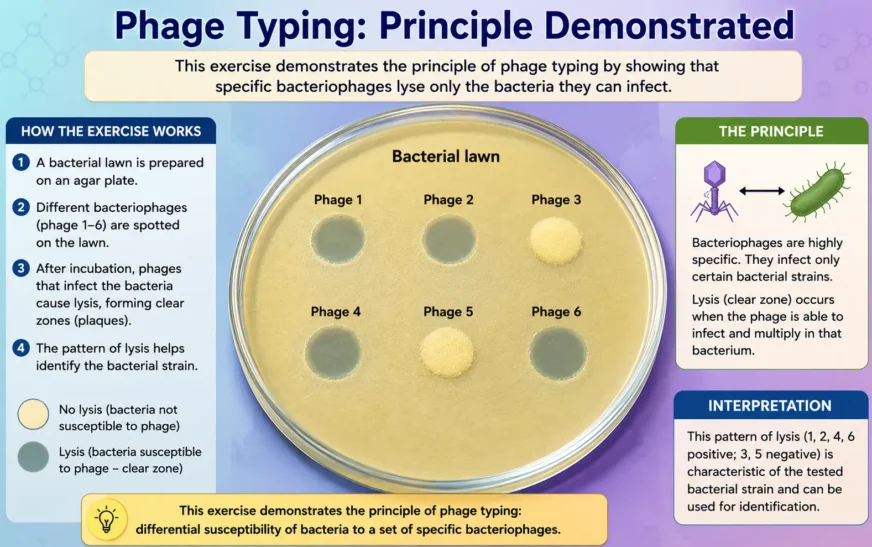
When you describe how this exercise demonstrates the principle of phage typing, you are really explaining bacterial specificity in a very clear way. A set of known bacteriophages is tested against a bacterial lawn, and only the strains those phages can infect will show clear zones or plaques. That visible pattern is the heart of phage typing, and it is what makes the exercise so useful for learning the idea quickly.
What Phage Typing Is Really Testing
Phage typing is not about guessing a bacterium by appearance. It is about testing whether a bacterial strain is susceptible to a particular bacteriophage. Bacteriophages are viruses that infect only bacterial cells, and they usually show strong host specificity, sometimes down to a particular strain within a species.
That is the key idea behind the exercise. You are comparing one unknown bacterial isolate against a known panel of phages and watching for lysis. If a phage can infect and replicate in that bacterium, it leaves a clear sign behind. If it cannot, the bacterial lawn stays intact.
How the Exercise Is Set Up
The usual setup is simple. A bacterial sample is spread across agar so it forms a lawn, and different phages are added to separate areas or spots. After incubation, the areas where the phage successfully infects the bacterium show plaques or clearings because the bacteria have been lysed.
That layout matters because it turns an invisible biological relationship into something you can see. Instead of reading a long list of traits, you look at the pattern of clear and cloudy areas on the plate. The exercise demonstrates that phages do not act on every bacterium in the same way. They act only where the host is susceptible.
Why Some Spots Clear and Others Do Not
The clear spots are the important part of the result. They show that the phage found a suitable bacterial host, entered the lytic cycle, replicated, and caused cell lysis. Where there is no clearing, the phage did not successfully infect that strain under the test conditions.
This is where the principle becomes easy to understand. The exercise shows differential susceptibility. One phage may clear one strain, while another phage leaves it untouched. That difference is not random. It reflects the biological match between the phage and the bacterial surface it needs in order to begin infection.
What the Pattern Tells You
The pattern of lysis tells you more than a simple yes or no. In phage typing, the combination of which phages clear the lawn and which do not can help classify the bacterial isolate. That is why this method was used as a typing tool in clinical and epidemiological work.
The exercise demonstrates this idea very well because it shows that bacterial strains can look similar and still behave differently when exposed to the same phage panel. A strain that is lysed by one pattern of phages and resistant to another is not being identified by appearance. It is being identified by its response to infection.
Why This Is a Good Demonstration of Specificity
Phage typing works because phages are selective. They attach only to bacterial cells they can recognize, then proceed only if the host cell is suitable. That specificity is the core reason the exercise works at all. Without host specificity, every phage would behave the same, and the test would have no typing value.
You can think of the exercise as a match test. The phage is the probe, and the bacterium is the target. A match gives you a clear area on the plate. A mismatch gives you no change. That simple contrast is exactly how the exercise demonstrates the principle of phage typing.
Why the Exercise Matters in Real Laboratory Work
This method was not just a classroom idea. The CDC served as a national reference center for bacteriophage typing of staphylococci and distributed standard phage sets for reference work. That tells you phage typing had enough practical value to support real laboratory identification and comparison of strains.
The NHMRC case study also shows how phage typing was used in infection control and outbreak investigation. In that setting, the lysis pattern helped laboratories compare isolates and follow the spread of bacterial strains across hospitals and regions. So the exercise is not only about seeing plaques. It is about understanding how microbiologists use susceptibility patterns to make sense of bacterial variation.
What the Exercise Does Not Prove
The exercise shows susceptibility, but it does not tell you everything about the bacterium. It does not explain every gene, every resistance trait, or every clinical feature. It only shows how that strain behaves against the phages in the test panel under those conditions.
That is an important point, because a clean plate does not always mean the bacterium is biologically simple. It may just mean the phage panel did not contain a matching phage for that strain. In the same way, a positive clearing only means that the phage could infect and lyse the host in that test. It is a strong clue, not a full genetic profile.
A Fresh Way to Explain the Exercise
A lot of explanations stop at saying that phage typing uses bacteriophages to identify bacteria. That is true, but it can sound too flat. A better way to explain it is to say that the exercise makes bacterial vulnerability visible. You are not looking at the bacterium itself. You are looking at how it responds when challenged by a known set of phages.
That is the fresh angle many articles miss. The real lesson is not only identification. It is the idea that biological relationships can be read from patterns of infection. The plate becomes a map of which phage can overcome which bacterial strain, and that is why the exercise is such a clear demonstration of phage typing.
Why Slow Growth Can Make the Test Harder
One limitation also becomes visible through this exercise. Phage typing depends on bacterial growth because the bacteria must form a lawn before the clearing pattern can be read. For slow-growing organisms, that can make the method time-consuming or less practical.
That limitation helps explain why the test is best understood as a classic microbiology principle rather than a universal shortcut. The biology has to cooperate. The bacterium has to grow well enough, the phage has to find the right host, and the result has to be clear enough to interpret. That is part of what makes the exercise educational. It shows both the power and the limits of the method.
How to Write the Answer in an Assignment
If you need a clean assignment-style answer, keep it focused on three points. First, the exercise shows that bacteriophages are specific to certain bacterial strains. Second, it shows that infection leads to lysis, which appears as clear zones or plaques on the lawn. Third, the pattern of clearing can be used to distinguish one bacterial isolate from another.
A strong answer does not need fancy language. It just needs to connect the observation to the principle. The exercise demonstrates phage typing because it shows differential susceptibility in a visible way. That is the whole logic of the method, and it is why the result is so easy to read on the plate.
FAQs
What is the principle of phage typing?
The principle of phage typing is that different bacterial strains respond differently to different bacteriophages. If a phage can infect the strain, it causes lysis and produces a clear zone on the bacterial lawn.
Why do some bacteria get lysed while others do not?
Some bacteria are susceptible to a given phage and others are not because phages are highly specific to their hosts. The infection only proceeds when the phage can successfully attach, replicate, and lyse that bacterial cell.
What does a clear plaque mean in this exercise?
A clear plaque means the phage infected the bacterium and destroyed cells in that area. It is the visible sign that the strain was susceptible to that phage under the test conditions.
How does this exercise help identify bacteria?
It helps by showing a pattern of susceptibility that can be compared with known phage reactions. That pattern can help classify the isolate and distinguish it from other strains of the same species.
Is phage typing still useful?
Phage typing is best understood today as a classic microbiology and epidemiology method, especially valuable for teaching the idea of phage specificity. Historical reference centers and outbreak work show that it once played an important practical role in laboratory typing.
Conclusion
This exercise demonstrates phage typing by turning bacterial specificity into a visible pattern on an agar plate. When a phage clears one strain and leaves another untouched, you can see the principle of differential susceptibility in action. That is the clearest way to understand how phage typing works and why it mattered in laboratory identification.
For more practical, easy-to-follow content like this, visit paulaprofit.com.