









Introduction
If you want to know whether a product or service is truly making money, how to calculate gross profit is the first thing to learn. It shows what stays after direct costs are removed, so you can see the real strength of your sales. In this guide on how to calculate gross profit, you will get the formula, simple examples, and the mistakes that can throw the answer off.
What Gross Profit Means
Gross profit is the money left after you subtract the direct cost of making or buying the goods you sold. Those direct costs are usually called cost of goods sold or COGS. Gross profit does not include rent, marketing, office bills, taxes, or other operating expenses.
That is why gross profit is such a useful number. It tells you how well your core product or service is performing before the rest of the business expenses are added. If gross profit is weak, the problem is often in pricing, sourcing, or production costs.
How to Calculate Gross Profit
Use the Basic Formula
The basic formula is simple.
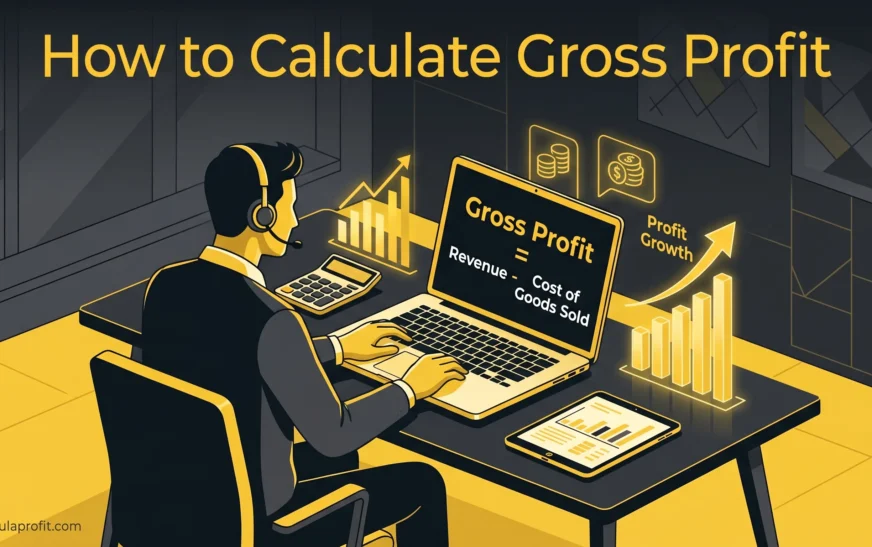
Gross profit = revenue – COGS.
Revenue is the total money you bring in from sales. COGS is the direct cost tied to those sales. Once you subtract COGS from revenue, you get gross profit.
A Simple Example
Let us say your business made $10,000 in sales. Your direct costs for those sales were $6,000. The gross profit is $4,000.
That means the business kept $4,000 before rent, salaries, ads, and other operating costs were paid. This is the cleanest way to understand how to calculate gross profit in a real business setting.
How to Find Gross Profit Percentage
A lot of people also want the gross profit percentage. That is the same idea, but written as a ratio of sales.
Gross profit margin = gross profit ÷ revenue × 100.
Using the same example, $4,000 ÷ $10,000 = 0.40. Multiply by 100 and you get 40%. So the gross profit margin is 40%. This number helps you compare different products, different months, or even different businesses.
What Counts as COGS
COGS includes the direct costs tied to what you sold. For a product business, that usually means raw materials, direct labor, and other production costs. For a service business, it can include the direct cost of delivering that service.
COGS does not include overhead costs like rent, office salaries, advertising, insurance, or admin work. If you put those costs into COGS by mistake, your gross profit will look lower than it really is.
Why Gross Profit Matters
Gross profit helps you see if your pricing is healthy. It also helps you spot whether your costs are rising faster than your sales. That makes it one of the most useful numbers for business owners who want a fast read on performance.
It also helps you compare products. A product can sell well and still be a weak performer if the direct cost is too high. That is why many businesses check gross profit before they look at net profit.
Gross Profit vs Gross Profit Margin
Gross profit tells you the dollar amount left after direct costs. In contrast, gross profit margin shows what percentage of your sales remains after those costs. Both numbers are connected, but they are not the same.
A simple way to remember this is to focus on what each one answers. Gross profit shows how much money you keep. On the other hand, gross profit margin explains what portion of your revenue stays with you. Once you get this difference, how to calculate gross profit becomes much easier to apply in real business decisions.
How to Calculate Gross Profit for a Service Business
Service businesses can use the same idea. You still subtract the direct cost of delivering the service from the money earned. The exact cost may look different from a product business, but the logic stays the same.
For example, a freelancer might count subcontractor fees or direct project costs as part of COGS. Once those direct costs are removed, the remaining amount is the gross profit. That is why how to calculate gross profit matters for service work too, not just for physical products.
Common Mistakes People Make
One common mistake is mixing operating expenses into COGS. Rent, marketing, and office costs belong after gross profit, not inside it. If you mix them together, you lose the real picture of product performance.
Another mistake is confusing gross profit with net profit. Gross profit only removes direct costs. Net profit removes everything else too, so it is always the later number in the income statement.
A Better Way to Read the Number
The most useful way to think about gross profit is this. It shows how much room you have left before the rest of the business starts spending money. If that room is too small, your pricing or cost structure may need work.
That is why many owners check gross profit before they make big decisions. It can help you decide whether to raise prices, lower production costs, or drop a low margin product. When people search for how to calculate gross profit, they often want this exact kind of practical answer.
FAQ’s
Q1. What is 25% GP?
If you mean a 25% gross profit margin, that means 25% of sales is left after direct costs. So if a product sells for $100, the gross profit is $25 and the direct cost is $75.
Q2. How to calculate 20% GP?
If you mean a 20% gross profit margin, take 20% of the sales price. On a $100 sale, the gross profit is $20 and the direct cost is $80.
Q3. What is 20% profit of $100?
It is $20. If the $100 is your sales amount and you mean gross profit margin, then $20 is the gross profit and $80 is the direct cost.
Q4. What is the formula for gross profit?
The formula is gross profit = revenue – COGS. Revenue is the total sales amount and COGS is the direct cost tied to those sales.
Q5. How do you calculate GP percentage?
Use this formula. Gross profit margin = gross profit ÷ revenue × 100. If gross profit is $4,000 and revenue is $10,000, the GP percentage is 40%.
Conclusion
Now you know how to calculate gross profit in a simple and practical way. Start with revenue. Subtract direct costs. Then use the result to judge pricing, cost control, and product strength. If you want to test the numbers while you work through them, visit Perimeter Calculator for a quick calculation tool.