
Introduction
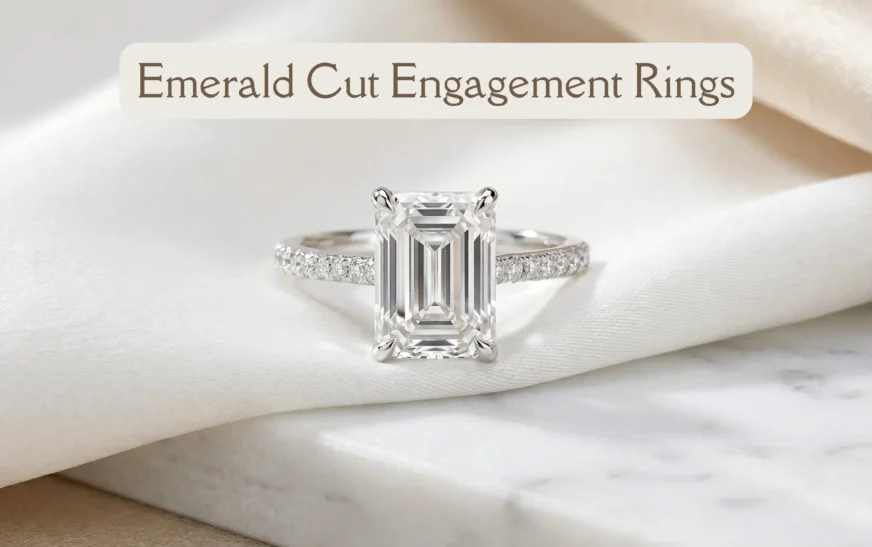
Emerald Cut Engagement Rings are diamond rings with a rectangular diamond shape and a step-cut design. This cut doesn’t have flashy sparkles but rather clean and clear reflections giving it a simple elegant look that makes the ring even more beautiful.
These rings are especially for those who prefer a neat and classy style over overly shiny designs. Its look is both modern and a little classic, making it a popular choice.
In this article, we will explain in a simple way what are the special features of emerald cut engagement rings, and how you can choose the right ring for you.
What are Emerald Cut Engagement Rings?
Emerald Cut Engagement Rings are the rings in which the diamond is in a rectangular shape and its corners are slightly cut. Because of this, the stone does not look like a completely sharp square, but gives a slightly soft and balanced shape.
In this cut, there are straight lines inside the diamond that give a layered kind of feel. This design is called a step cut where the light does not sparkle directly but reflects on the surface and gives a clean mirror-like effect.
Because of this, emerald cut rings have a more simple and clear look. These are better for people who like neat and structured designs instead of heavy shine.
Key features of Emerald Cut Diamond
The most important thing about an emerald cut diamond is that its sparkle is not very strong; instead, the light reflects straight, which makes the diamond look clean and clear. That’s why this cut does not look flashy, but gives a simple and controlled shine.
In this cut, clarity is very important. Because the lines inside the diamond are straight, small flaws inside it can be easily seen. When choosing an emerald cut, it is better to select a more clear diamond.
Its shape is also a strong feature. Because of the rectangular design and straight lines, the ring looks slightly longer and slimmer on the finger. This look suits people who like a clean and structured style.
Emerald Cut vs Other Diamond Shapes
If I talk straight, the difference between an emerald cut and a round diamond is understood by the eye first. A round diamond shines more because its cut is such that light comes back from every angle. Emerald cut is completely the opposite of this. In it, the shine does not come loudly. The light comes straight and goes back straight. That’s why its look feels more clean and a bit calm.
People often put oval and emerald in the same category, but the feel of both is completely different. Oval is soft, a bit rounded, and looks smooth to the eye. Emerald cut is straight, the lines are clear, and the shape looks disciplined. That’s why someone who likes clean and straight design usually goes towards emerald.
Now if we talk about radiant cut, it is all about sparkle. If someone wants a ring that shines even from a distance, then radiant is better for them. Emerald cut stands different there as well. It does not show off much. Its charm is understood when you look at it a bit closely. Simple thing—if you want more shine, go for radiant. If you want a clean and composed look, go for emerald cut.
How to Choose Emerald Cut Engagement Rings
If you are thinking of buying an emerald cut ring, the first thing you should look at is clarity. In this cut, everything is visible. Any small line or mark inside the diamond will not stay hidden. In round cuts, flaws can sometimes be hidden. Not here. That’s why choosing a slightly better clarity is safer, otherwise you may regret it later.
You also cannot ignore color here. Emerald cut shows light directly, so even a slight yellow tone becomes noticeable quickly. I always say that in this cut, go for a cleaner color. It is not necessary to take a very high grade, but it should be good enough that the stone does not look dull.
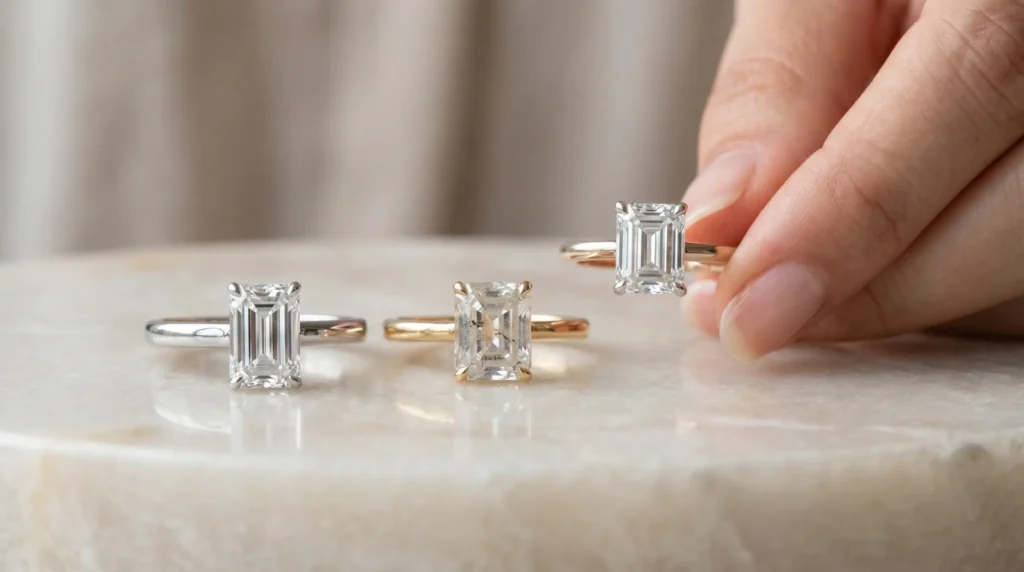
Now understand the balance of size and shape. Not every rectangular diamond looks good. Some are too long and look odd on the finger. Some are too short and don’t give the full effect. It’s better to choose a piece that does not look too thin or too square. If it feels balanced to the eye, then it’s right.
If I talk about the setting, emerald cut does not need much decoration. This cut is already enough on its own. It looks best in a simple solitaire. If you want a bit of design, a three-stone setting also works, but over-design does not suit this cut. Its real beauty is in its straight lines, and it does not need to be covered.
Common Mistakes to Avoid
Compromising on clarity
The most common mistake I have seen is that people compromise on clarity, and when the price is a bit lower, it feels like they got a good deal, but that is just your misunderstanding.
In emerald cut, this thing is understood later. If the stone is not clean, the eye keeps getting stuck on it every time. In this cut, it is better to choose a slightly cleaner diamond.
Ignoring the shape
The second mistake is ignoring the shape. Not every rectangular diamond looks good. Some are so long that they look odd on the finger. Some are so wide that their classic look is lost. When buying, always choose a piece that looks straight and balanced to the eye.
Choosing an Over-Designed Setting
The third mistake is related to the setting. People think that more design means more beauty, but with emerald cut, this thinking does not work.
Too much design hides its natural lines. If you keep it simple, the stone speaks for itself. Otherwise, the ring starts to look too busy.
Only choosing based on size
The last mistake I often see is that people get impressed by size and buy the piece thinking they won’t find such a big stone again, but later they don’t even like it. This happens because they only looked at the large stone and ignored everything else.
In emerald cut, balance is the most important thing. Even if you choose a slightly smaller one, if it is clean and properly proportioned, it looks much better in my opinion.
Conclusion
If I speak honestly, Emerald Cut Engagement Rings are not for everyone, but for people who like a clean and simple look, it can be one of the best choices. The charm of this cut is in its straight lines and clear look.
Just remember a few basic things. Go for good clarity, keep the shape balanced, and keep the setting simple. If you take care of this much, the chances of mistakes become very low. The rest is simple—whatever ring looks right to the eye at first glance, that is the right one.
FAQ’s
Q1. Are Emerald Cuts More Expensive?
Emerald cut is not very expensive, and it can often be found at a slightly lower price than a round diamond. The reason for this is that it has less sparkle. But if both clarity and color are very good, then the price can be higher. So, the price depends more on quality than on the cut.
Q2. How Many Carats is a $10,000 Engagement Ring?
The simple answer is that in $10,000, you usually see a diamond between 1.5 to 2.5 carats. But this directly depends on how high the quality you are choosing.
If you want top clarity and color, then the size usually stays around 1 to 1.5 carats. And if you make a little compromise or choose a lab-grown option, then in the same budget it is possible to go up to 2 carats or even slightly more.
Q3. How Large is Taylor Swift’s Diamond?
Taylor Swift’s engagement ring diamond is considered quite large. According to experts, it is roughly between 7 to 10 carats, and some people even estimate it up to 13 carats.
It is an antique-style cushion cut (old mine cut) diamond set in an 18k yellow gold setting. The exact details are not confirmed, but both the size and design are very noticeable.
Q4. How Much Does a 1 Carat Emerald Ring Cost?
In the market, the price of a 1 carat emerald ring varies a lot. Usually, a decent quality one can be found between $1,000 and $3,000, while a good quality deep green stone can go up to $5,000 or more.
Color and clarity matter the most, so the price is not decided only by carat size.
Q5. Is Emerald More Expensive than Diamond?
Yes, top-quality emeralds can be more expensive than diamonds of similar size, largely because high-quality emeralds are significantly rarer than diamonds. While diamonds are popular, emeralds are roughly 20 times rarer, often leading to higher per-carat prices for fine specimens.