









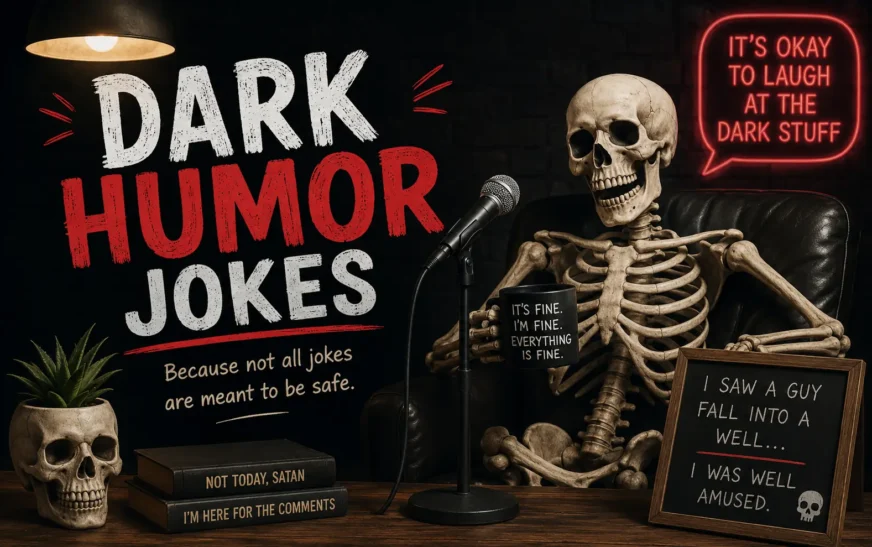
Dark humor jokes use uncomfortable, grim, or morbid material and turn it into comedy through irony, contrast, and timing. Dictionaries define black humor as humor marked by usually morbid, ironic, grotesquely comic episodes, while Britannica describes black humour as writing that joins morbid or ghastly elements with comic ones.
The competitor article leans heavily on long joke lists, repeated one-liner formats, and many category headings. That approach gives volume, but it does not spend much time explaining why the humor works or where the line sits.
[Insert Contextual Internal/External Link to Authority Source]
What Dark Humor Jokes Really Are
Dark humor is not just “jokes about bad things.” It is a style built on friction, where the joke places serious subject matter beside a playful or absurd twist. Britannica explains humor as a collision of frames of reference, which is a useful way to think about dark comedy too: the mind holds two meanings at once, and the snap between them creates the laugh.
That is why dark humor often feels sharper than ordinary wordplay. The joke lands because it does not announce itself in a straight line; it lets the listener walk into the contrast and realize the twist a beat later. Merriam-Webster also treats “dark” in this context as tied to grim or depressing circumstances, which matches the tone people mean when they search for dark humor jokes.
Why This Kind of Joke Works
The strongest dark humor usually depends on distance. When the joke creates enough emotional space, the audience can see the shape of the idea instead of getting trapped inside the raw subject itself. Britannica’s discussion of humor through tension, collision, and release fits this pattern well.
Timing matters just as much as subject. A joke can be technically clever and still fail if it arrives too early, too bluntly, or with no setup at all. In practice, the laugh comes from the surprise of the turn, not from shock alone.
[Insert Contextual Internal/External Link to Authority Source]
What Makes Dark Humor Feel Smart Instead of Cheap
A good dark joke usually has a second job. It may expose hypocrisy, highlight absurdity, or make a heavy subject feel less overpowering without pretending that the subject is harmless. Britannica notes that black humour often uses farce and low comedy to underline senselessness or futility, which explains why the best examples feel intelligent rather than random.
Cheap dark humor does the opposite. It relies on cruelty, lazy shock, or easy targets, and it usually leaves the reader with nothing except discomfort. Smart dark humor keeps the target broad, the wording tight, and the punchline clever enough to stand on its own. That distinction matters more than people realize.
A Clean Framework for Writing Dark Humor Jokes
Start with a safe angle, not a reckless one. Pick a theme with a little bite, then move the joke toward absurdity, irony, or exaggeration instead of cruelty. That shift keeps the line funny instead of mean.
Build contrast next. Put a serious setup beside an unexpectedly playful ending, because the tension between those two tones does most of the work. Britannica’s explanation of comic effect through colliding frames gives you the exact logic behind this method.
Leave room for the listener to connect the dots. If you explain everything, the joke loses its snap, and the hidden logic disappears before the laugh arrives. The best line sounds simple on the surface and smarter on the second look.
Protect the target at the end. A strong dark joke should point at a situation, an idea, or a shared human weakness rather than a vulnerable person. That choice keeps the humor sharp without turning it into cheap harm.
Dark Humor Jokes Example Style
“My calendar has a dark sense of humor. It keeps booking my free time for later.”
“My vampire friend got a day job. He said the night shift was too draining.”
“I tried to write a grave joke, but it kept getting buried under better ideas.”
“My skeleton started therapy, and now he says he has a lot of issues to bone through.”
These lines stay on the safer side because they lean on wordplay, spooky imagery, and absurdity instead of real-world pain. That is the sweet spot for readers who want the dark tone without the nasty edge.
When Dark Humor Crosses the Line
Dark humor stops working the moment it starts punching down. If a joke depends on mocking real suffering, identity, trauma, or someone’s private pain, the laugh usually disappears and the damage takes over. That is where the style changes from clever to careless.
A better rule is simple: if the punchline needs a victim, rewrite it. If the punchline can survive as wordplay, irony, or absurdity, it probably belongs in the joke. That filter keeps the writing stronger and the audience more open.
[Insert Contextual Internal/External Link to Authority Source]
How to Use Dark Humor Jokes in Real Life
Use them with people who already share your tone. Even a well-written joke can fall flat if the room wants something lighter, warmer, or more direct. Good timing is social timing too.
Keep the setting in mind as well. A joke that works in a casual chat may feel wrong in a serious conversation, and a line that reads fine on a screen may land very differently in person. The joke does not live alone; the moment around it shapes the result.
Why People Search for Dark Humor Jokes
People usually search this keyword for one of three reasons. They want a quick laugh, they want examples for writing, or they want to understand the style before using it themselves. The highest-value article should cover all three, not just throw out a long pile of punchlines.
That is also why a list-only page often feels thin after the first few minutes. Readers remember the structure when the article explains the mechanics behind the joke, not just the joke itself. The deeper article gives them something they can actually reuse.
FAQs
What are dark humor jokes?
Dark humor jokes turn grim, morbid, or uncomfortable material into comedy through irony, contrast, and timing. Merriam-Webster and Britannica both describe the style as humor built around morbid or ghastly elements.
Why do dark humor jokes make people laugh?
They create tension between a serious idea and a playful twist, and the brain enjoys resolving that gap. Britannica explains humor as the collision of different frames of reference, which fits dark comedy very well.
Are dark humor jokes the same as offensive jokes?
No, not always. Dark humor can be smart, ironic, and playful, while offensive jokes often rely on cruelty or lazy shock.
How do I write a good dark humor joke?
Use a safe angle, build contrast, and end with a twist that feels clever instead of mean. Keep the target broad and the wording tight.
Can dark humor jokes work for social media captions?
Yes, but only when the tone matches the audience. Short, clean lines usually work better online because they are easier to read, remember, and share.
Next Steps
Treat dark humor like a craft, not a dare. Start with wordplay, irony, or absurdity, test the line for fairness, and keep editing until the joke lands cleanly without leaning on cruelty. That is the difference between a line people skim and a line people remember.
If you enjoy internet humor that catches people off guard, the Candice joke trend is one of the best examples of how simple setups can turn into viral punchlines. Its entire format depends on surprise, timing, and the reaction that follows.



One thought on “Dark Humor Jokes: Meaning, Timing, Boundaries, and How to Write Them Well”